
By Mohammed (Operations Manager) & Musthafa (Sales Head) — Quickstep Business Setup
Every month, our operations and sales teams work through a high volume of trade licence applications across mainland Dubai and multiple free zones. Some move fast — initial approval in 24 hours, full licence in hand within the week. Others stall, get sent back, or create expensive problems three months down the line.
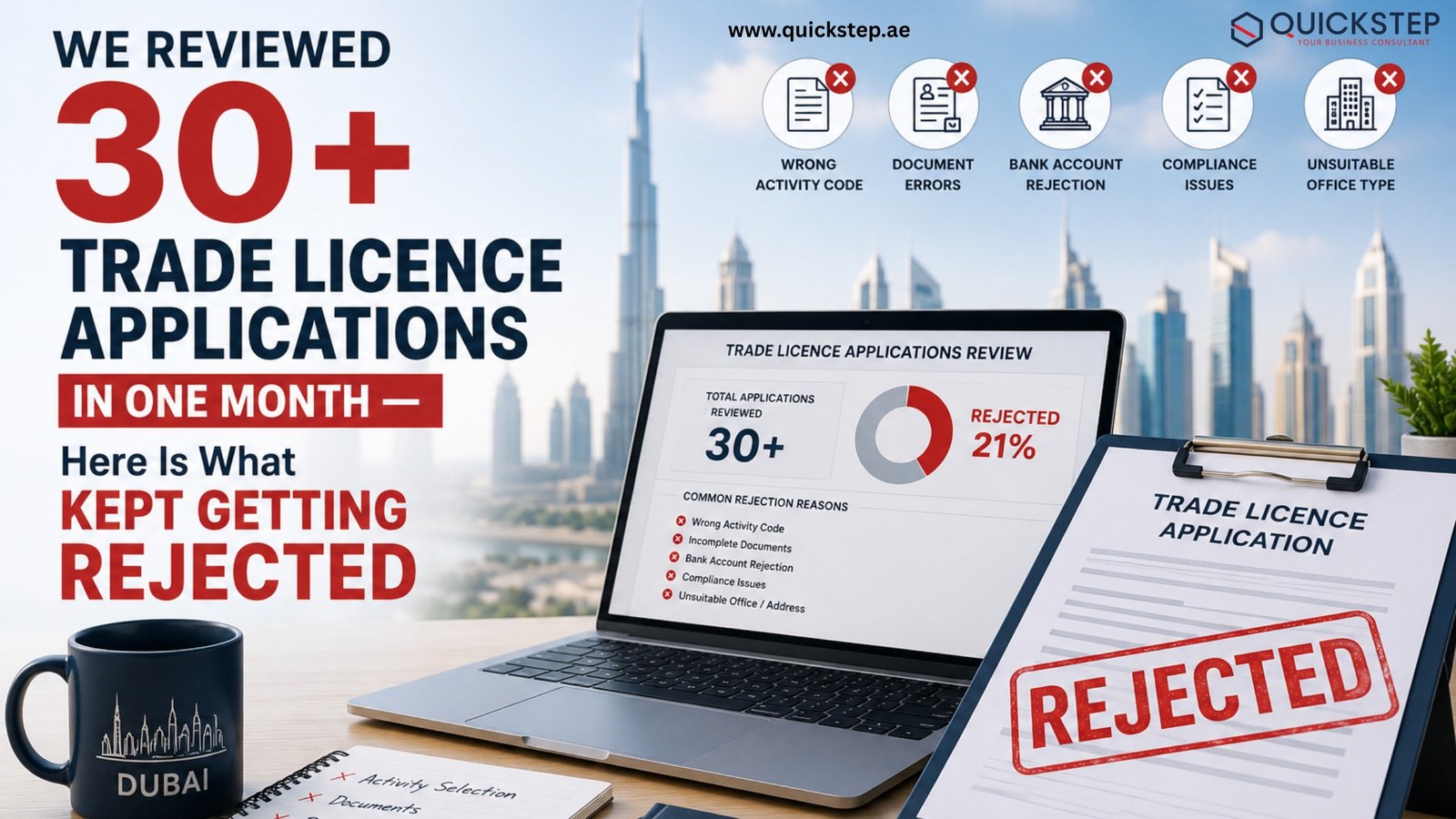
After reviewing over 30 applications processed in a single month, one pattern was impossible to ignore: the rejections and delays were almost never caused by the government. They were caused by decisions made before the application was even submitted.
Here is exactly what kept going wrong.
Mistake 1: Picking an Activity Code Without Understanding What It Covers
This was the single most common issue we saw — across new setups, amendments, and free zone applications alike.
A client setting up an IT services company selected “General Trading” because it sounded broad enough to cover everything. It does not. When the bank reviewed the licence, the activity mismatch triggered an immediate red flag. The account application was rejected. The client then had to amend the licence — paying additional fees and losing three weeks — before reapplying.
Activity selection is not a form-filling decision. It is a business strategy decision. The activities listed on your trade licence determine what contracts you can legally sign, what banking facilities you can access, and what visa categories your employees are eligible for.
Getting this wrong does not just delay your setup. It follows you.
Mistake 2: Optimising for the Cheapest Licence
Musthafa’s sales team hears this question more than any other: “What is the cheapest licence option?”
There is nothing wrong with cost awareness. The problem is when the cheapest option is chosen without understanding what it does not include — and the consequences show up later.
We reviewed multiple cases where clients had selected the lowest-cost free zone package available, only to discover that it came with a visa quota of one, a virtual office address that certain banks would not accept, and a renewal cost structure that made the second year significantly more expensive than the first year appeared to be.
The total cost of a trade licence is not the number on the invoice. It is the cost of the licence, plus the office arrangement, plus the visa quota you actually need, plus the renewal cycle, plus whether your banking setup works from day one.
Cheap upfront. Expensive in practice. We see it regularly.
Mistake 3: Arriving Without a Business Plan
This one is specific to a particular type of client — and it is almost always IT companies and early-stage digital startups.
The trade licence is approved. The client is ready to open a corporate bank account. The bank asks: what does your business do, who are your clients, what is your revenue model, and do you have any contracts or agreements in place?
The client has none of that prepared.
Banks in the UAE do not view an IT or consulting licence as self-explanatory. Without a clear business plan — a documented description of services, a revenue model, a client profile — IT and digital companies carry the highest bank account rejection rate of any sector we work with. Payment gateway applications face the same scrutiny.
A trade licence gives you legal status in the UAE. A business plan gives you banking. You need both.
Mistake 4: Documentation Errors That Are Entirely Avoidable
Name mismatches between a passport and an application form. A spelling error in a submitted MOA. A sector-specific approval that was not obtained before the licence application was filed.
These are not complex problems. They are entirely avoidable problems — and they caused a meaningful number of the delays we tracked in that month.
Healthcare businesses in particular consistently underestimate this. Operating a healthcare-related activity in Dubai requires DHA or MOH approval before a trade licence has any practical use. Clients who applied for a trade licence without first understanding this track lost weeks waiting for approvals they had not anticipated needing.
Food and beverage businesses face the same reality with Dubai Municipality. The food licence process runs on a longer timeline than a standard commercial licence — typically double — and requires kitchen setup inspections and hygiene certifications that cannot be fast-tracked regardless of how quickly the trade licence itself is issued.
One document check before submission. That is the entire solution.
Mistake 5: Treating the Licence as the Finish Line
A number of the applications we reviewed in that month were not new setups. They were emergency renewals — clients who had let their trade licence lapse past the grace period and were now dealing with the consequences.
An expired trade licence in Dubai is not a minor administrative issue. It suspends your ability to sponsor visas. It can trigger fines. In some cases, it risks company blacklisting — a status that creates significant complications when you attempt to renew or apply for any government service.
VAT registration was the other compliance gap we saw. Businesses that had crossed the registration threshold months earlier had still not registered with the Federal Tax Authority (FTA) through the EmaraTax portal. The licence was active. The business was operating. The compliance layer was completely ignored.
Getting the licence is step one. Staying compliant with the DET, FTA, and GDRFA on an ongoing basis is the actual job.
Mistake 6: Misunderstanding What a Virtual Office Actually Covers
The question Musthafa’s team gets asked almost every week: “A virtual office is fine, right?”
Sometimes yes. Often no.
Office type is not just a cost decision. For mainland DET licences, a physical office with a registered Ejari is required — a virtual office will not satisfy that requirement. For free zone licences, a virtual office or flexi desk may be sufficient for the licence itself, but if your activity requires government inspections, or if you need more than the minimum visa quota, a flexi desk creates a hard ceiling on what your company can do operationally.
Several clients in that month had chosen virtual office arrangements and then discovered — during bank account applications — that their registered address did not meet the bank’s operational substance requirements. The licence was valid. The banking door was closed.
Office type determines your visa quota, your inspection compliance, and your banking eligibility. It is not just an address on a document.
What the Smooth Applications Had in Common
The applications that moved without friction shared the same profile every time.
The client had a defined business idea with a clear service description. They had document flexibility — not fixated on the cheapest option. They thought in terms of a two to three year operating plan, not just getting a licence issued. And they had their documents accurate and complete before the first consultation.
Preparation is the single biggest competitive advantage in a Dubai business setup. The government process is not the bottleneck. Readiness is.
From Mohammed, Operations Manager: “A trade licence is not a form-filling process — it is a business strategy. The clients who move fastest are the ones who understand that before they come to us. The ones who struggle are the ones who realise it after.”
The step-by-step process for getting your trade licence right from the start is covered in full here: How to Get a Trade Licence in Dubai in 2026: The Complete Step-by-Step GuideIf you want to avoid every mistake on this list before your application is submitted, speak with Quickstep’s team directly: [Trade Licence & Company Formation] (service page placeholder)
FAQs
What is the most common reason a Dubai trade licence application gets delayed? Wrong activity code selection is the most frequent cause. Choosing an activity that does not accurately reflect your business model creates downstream problems with banking, visa applications, and legal contracts — and requires a paid amendment to correct.
Can a virtual office be used for a mainland Dubai trade licence? No. DET mainland licences require a physical office space with a valid Ejari registration. A virtual office does not satisfy this requirement. Free zone licences may accept a flexi desk, but restrictions apply depending on activity type, visa quota needs, and banking requirements.
Why do IT companies have the highest bank account rejection rate in Dubai? Banks in the UAE require demonstrable operational substance from IT and consulting companies. Without a documented business plan, named client base, or revenue model, an IT licence alone does not provide sufficient evidence of a viable business — which triggers enhanced due diligence or outright rejection.
What happens if a Dubai trade licence expires without renewal? An expired trade licence suspends your visa sponsorship authority, triggers accumulating fines, and in serious cases can result in company blacklisting. Renewal should be initiated at least 30 days before the expiry date to avoid any operational disruption.
Do healthcare businesses need more than a trade licence to operate in Dubai? Yes. Healthcare activities require regulatory approval from either the Dubai Health Authority (DHA) or the Ministry of Health (MOH) in addition to a trade licence. Operating without this approval is a compliance violation regardless of whether the trade licence itself is valid.