
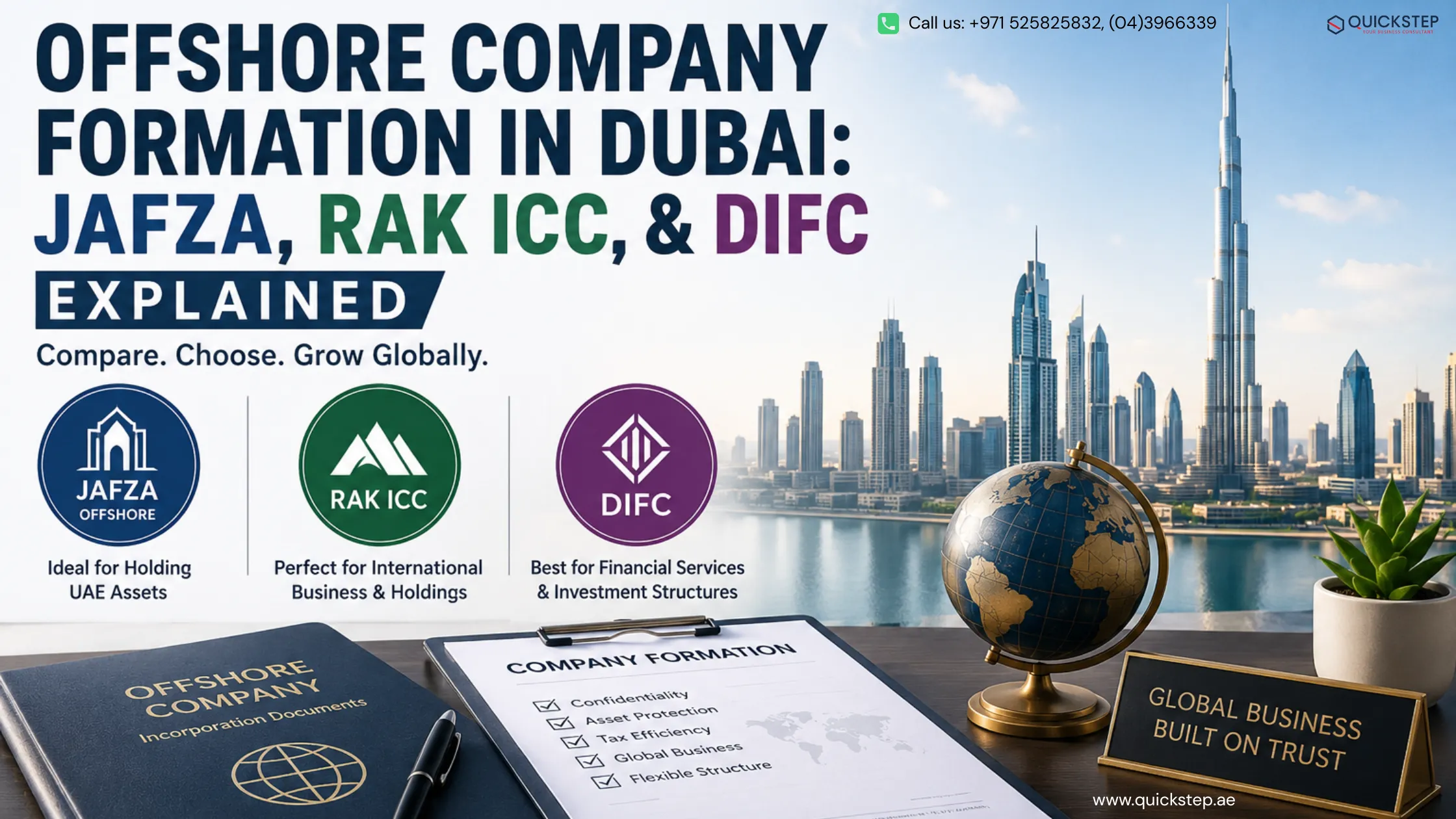
Unlike JAFZA Offshore or RAK ICC, DIFC is not a traditional offshore registry. Instead, it offers specialised legal structures designed for businesses that require a sophisticated corporate environment.
These structures are commonly used by:
- Family offices
- Investment funds
- Private wealth managers
- International financial institutions
- Venture capital firms
- Holding companies with regional investments
DIFC is particularly attractive to organisations seeking a globally recognised financial jurisdiction with strong governance standards.
JAFZA vs RAK ICC vs DIFC: Which One Is Right for You?
Each jurisdiction serves a different purpose. The best choice depends on your business goals, investment strategy, and future plans.
| Feature | JAFZA Offshore | RAK ICC | DIFC |
| Best For | Holding UAE assets | International business & holding companies | Financial services & investment structures |
| Location | Dubai | Ras Al Khaimah | Dubai |
| Legal Framework | JAFZA Regulations | RAK ICC Regulations | DIFC Laws |
| Suitable for Holding Companies | ✔ Excellent | ✔ Excellent | ✔ Excellent |
| International Reputation | High | High | Very High |
| Property Ownership (where permitted) | ✔ Yes | Depends on regulations | Depends on structure |
| Financial Services | No | No | ✔ Yes |
| Banking Reputation | Strong | Strong | Excellent |
There is no single “best” offshore jurisdiction. The right option depends on your objectives, the countries where you operate, and the type of assets your company will own.
Which Offshore Structure Should You Choose?
Choosing the correct jurisdiction starts with understanding what you want your company to achieve.
Choose JAFZA Offshore if:
- You plan to hold qualifying real estate in Dubai.
- You need a Dubai-based offshore company.
- You want a recognised corporate structure for long-term asset ownership.
- Your business focuses on investments rather than active trading.
Choose RAK ICC if:
- You operate internationally.
- You need a flexible holding company.
- You plan to own shares in multiple businesses.
- You require a cost-effective offshore structure.
- Your business operates across several countries.
Choose DIFC if:Thinking about starting an offshore company in Dubai but not sure which option is right for you?
The short answer is this:
An offshore business setup in Dubai allows you to own international assets, protect investments, simplify global business operations, and benefit from a business-friendly environment in the UAE. The right jurisdiction depends on your business goals. JAFZA Offshore is popular for holding UAE assets, RAK ICC is widely used for international business and holding structures, while DIFC is better suited for businesses connected to financial services and wealth management.
Choosing the correct structure from the beginning can save time, reduce administrative work, and support your long-term business plans.
In this guide, you’ll learn how offshore companies work in the UAE, compare the leading offshore jurisdictions, understand their benefits and limitations, and discover which option is best for your business.
What Is an Offshore Company in Dubai?
An offshore company is a legal business entity incorporated in the UAE for conducting business activities outside the country. Unlike mainland companies, offshore companies are generally not permitted to trade directly within the UAE local market unless they obtain the required approvals or establish an appropriate operating structure.
Many entrepreneurs, investors, and multinational businesses choose offshore companies because they provide a practical way to own international investments, manage intellectual property, hold shares in other companies, or own property where permitted under UAE regulations.
Although the term “Dubai offshore company” is commonly used, offshore companies are governed by specific authorities rather than the Dubai mainland licensing system.
The most recognised offshore jurisdictions include:
- JAFZA Offshore (Jebel Ali Free Zone Authority)
- RAK International Corporate Centre (RAK ICC)
- Dubai International Financial Centre (DIFC) for qualifying structures
Each serves different business purposes and legal requirements.
How Does an Offshore Company Work?
Unlike a standard trading company, an offshore company is designed primarily for international activities.
It can be used to:
- Hold international investments
- Own shares in other companies
- Protect family assets
- Manage intellectual property
- Hold real estate where regulations permit
- Conduct international consulting and investment activities
- Facilitate cross-border transactions
However, offshore companies generally cannot conduct commercial business directly within the UAE mainland market without meeting additional legal requirements.
Instead, they operate internationally while enjoying the UAE’s well-established corporate framework and business-friendly environment.
Why Do Investors Choose Offshore Business Setup in Dubai?
Dubai has become one of the world’s preferred locations for international company formation due to its stable economy, strategic location, and internationally recognised legal framework.
According to the Dubai Chamber of Commerce, Dubai continues to attract thousands of new international businesses each year due to its position as a global trade and investment hub.
Some of the main reasons investors choose an offshore company include:
Asset Protection
Business owners often separate valuable assets from operating businesses by placing them under an offshore holding company.
This structure may reduce legal risks and simplify long-term ownership planning.
International Business Operations
Companies working with customers or suppliers in multiple countries often prefer an offshore entity because it provides a recognised corporate structure for international transactions.
Holding Company Structure
Many global investors establish offshore companies solely to own:
- International subsidiaries
- Company shares
- Intellectual property
- Investment portfolios
- Commercial property (where permitted)
This type of structure is commonly referred to as a holding company.
Business Privacy
Subject to applicable UAE laws and transparency requirements, offshore companies offer structured corporate ownership while complying with Ultimate Beneficial Owner (UBO) regulations.
Efficient Corporate Administration
Many offshore companies have fewer operational requirements than active trading companies because they typically do not employ staff or conduct local commercial activities.
Quick Tip
An offshore company is not the same as a mainland company or a free zone company. If your goal is to trade directly within the UAE market, hire employees locally, or open a retail office, an offshore company may not be the right choice. Choosing the correct structure at the start can save both time and future restructuring costs.
Offshore Company vs Mainland Company vs Free Zone Company
Choosing the right business structure is one of the most important decisions when setting up a company in the UAE.
The table below highlights the main differences.
| Feature | Offshore Company | Free Zone Company | Mainland Company |
| Trade within UAE | No (subject to regulations) | Limited | Yes |
| International Business | Excellent | Excellent | Excellent |
| Physical Office | Usually not required | Usually required | Required |
| Employee Visas | Generally not available | Available | Available |
| Asset Holding | Excellent | Good | Good |
| Own Shares in Other Companies | Yes | Yes | Yes |
| Property Ownership (where permitted) | Yes | Yes | Yes |
| Suitable for Holding Companies | Excellent | Good | Moderate |
Each structure serves different business objectives, making it important to evaluate your current operations as well as your long-term plans before making a decision.
JAFZA Offshore: An Overview
The Jebel Ali Free Zone Authority (JAFZA) introduced its offshore company regulations to support international investors looking for a reputable corporate structure within Dubai.
JAFZA Offshore companies are particularly popular among investors who wish to own qualifying real estate, establish holding companies, or manage international investments from a globally recognised jurisdiction.
Some key features include:
- Established within Dubai’s internationally recognised free zone
- Suitable for holding assets and investments
- Recognised corporate framework
- Can own shares in UAE and international companies where permitted
- Often chosen by family businesses and international investors
- Registered through approved JAFZA Registered Agents
JAFZA Offshore has built a strong reputation among investors seeking long-term asset ownership and succession planning.
RAK ICC Offshore: A Flexible Choice for International Business
The RAK International Corporate Centre (RAK ICC) is one of the UAE’s leading offshore company registries. Established in Ras Al Khaimah, it was created to support international investors, entrepreneurs, and family businesses looking for a flexible corporate structure for global operations.
Today, RAK ICC is widely used for:
- International trading
- Holding company structures
- Family wealth planning
- Investment companies
- Intellectual property ownership
- Global asset management
Unlike operating companies, a RAK ICC offshore company is mainly designed to manage international business interests rather than conduct commercial activities within the UAE mainland.
Why Many Investors Choose RAK ICC
RAK ICC has become popular because it offers a straightforward incorporation process and supports a wide range of international corporate structures.
Some advantages include:
- Suitable for international business activities
- Well-recognised offshore jurisdiction
- Flexible corporate ownership structure
- Supports holding companies and investment vehicles
- Can own shares in UAE and overseas companies where permitted
- Internationally accepted corporate documentation
- Registered through authorised corporate service providers
Many multinational business owners use RAK ICC as part of a broader international corporate structure that includes subsidiaries operating in different countries.
DIFC Structures Explained
The Dubai International Financial Centre (DIFC) is one of the world’s leading financial centres. It operates under an independent legal framework based largely on common law principles and serves businesses involved in financial services, investment management, private wealth, and international finance.
- You work in financial services.
- You manage private wealth.
- You operate an investment or family office.
- Your investors require an internationally recognised legal framework.
- Your business needs a sophisticated governance structure.
Before deciding, it’s advisable to discuss your business objectives with an experienced business setup consultant who understands UAE corporate regulations and can recommend the most suitable option.
Offshore Holding Companies Explained
One of the most common reasons entrepreneurs establish an offshore company is to create a holding company.
A holding company does not usually manufacture products or provide services directly. Instead, it owns valuable business assets.
These assets may include:
- Shares in other companies
- International subsidiaries
- Commercial real estate (where permitted)
- Intellectual property
- Investment portfolios
- Trademarks
- Patents
For example, a business owner with companies in the UAE, India, and the UK may use an offshore holding company to own shares in each operating business. This can simplify ownership management and succession planning.
Understanding Ultimate Beneficial Owner (UBO) Requirements
The UAE has strengthened its corporate transparency framework by introducing Ultimate Beneficial Owner (UBO) regulations.
A UBO is the individual who ultimately owns or controls a company, even if ownership is held through other legal entities.
During offshore company formation, businesses are generally required to provide information about:
- Shareholders
- Directors
- Beneficial owners
- Corporate ownership structure
These requirements help improve transparency and support international standards for anti-money laundering (AML) and counter-terrorist financing (CTF).
Maintaining accurate UBO records is an ongoing compliance requirement for many companies operating in the UAE.
Important
Providing incorrect or incomplete ownership information during incorporation can delay company registration or create future compliance issues. Always disclose ownership details accurately and keep company records up to date..
Documents Required for Offshore Company Formation
Although document requirements vary slightly between jurisdictions, applicants are generally asked to provide the following:
| Document | Individual Applicant | Corporate Shareholder |
| Passport Copy | ✔ Required | ✔ Required |
| Proof of Residential Address | ✔ Required | ✔ Required |
| Bank Reference Letter (where applicable) | May be requested | May be requested |
| Curriculum Vitae / Business Profile | Sometimes required | Sometimes required |
| Corporate Documents | — | ✔ Required |
| Shareholder Information | ✔ Required | ✔ Required |
| UBO Declaration | ✔ Required | ✔ Required |
Depending on the nature of the business, additional supporting documents may be requested by the relevant authority or registered agent.
Step-by-Step Offshore Company Formation Process
Although each jurisdiction follows its own procedures, the overall incorporation process is generally similar.
Step 1: Define Your Business Objectives
Identify why you’re establishing the offshore company.
Examples include:
- Asset protection
- International investments
- Holding company
- Intellectual property ownership
- Global business expansion
A clear objective helps determine the most suitable jurisdiction.
Step 2: Choose the Right Offshore Jurisdiction
Select the jurisdiction that best matches your business needs.
Factors to consider include:
- Long-term expansion plans
- Nature of the business
- Ownership structure
- Property ownership requirements
- Banking preferences
Step 3: Prepare Company Documentation
Gather all required identification documents, shareholder information, proof of address, and corporate records where applicable.
Step 4: Submit the Incorporation Application
Applications are submitted through an authorised registered agent or approved corporate service provider.
The relevant authority reviews the documents before approving the company registration.
Step 5: Receive Incorporation Documents
Once approved, you’ll receive the company’s official incorporation documents, which may include:
- Certificate of Incorporation
- Memorandum and Articles of Association
- Share Certificates
- Register of Directors
- Register of Shareholders
These documents are often required when opening a corporate bank account or conducting international business.
Offshore Company Formation Costs in Dubai
One of the first questions investors ask is, “How much does an offshore business setup in Dubai cost?”
The answer depends on several factors, including the offshore jurisdiction you choose, the type of business structure, and any additional services you require. There isn’t a fixed price that applies to every company.
Your total setup cost may include:
- Government incorporation fees
- Registered agent service fees
- Company registration charges
- Document preparation and certification
- Compliance and due diligence fees
- Corporate bank account assistance (if required)
- Additional legal or advisory services
The final cost can also vary depending on whether you choose JAFZA Offshore, RAK ICC, or another approved corporate structure.
Tip: Rather than focusing only on the lowest setup cost, consider the long-term suitability of the jurisdiction. The right structure can save time, reduce administrative work, and support future business growth.
Opening a Corporate Bank Account
Many entrepreneurs establish an offshore company to manage international business activities, investments, or holding structures. In these cases, opening a corporate bank account is often an important next step.
Banks usually conduct their own due diligence before approving an application. While requirements vary between financial institutions, they commonly review:
- Nature of the business
- Source of funds
- Company ownership structure
- Ultimate Beneficial Owner (UBO) details
- Business activities
- Compliance documentation
Approval timelines vary from one bank to another, and each institution applies its own risk assessment policies.
Working with an experienced business setup consultant can help you prepare the required documentation and choose a bank that matches your business profile.
Tax and Compliance Considerations
An offshore company should always operate in line with applicable UAE laws and international compliance standards.
Business owners should understand that company registration is only one part of ongoing compliance.
Depending on your activities, you may also need to consider:
- Ultimate Beneficial Owner (UBO) reporting
- UAE Corporate Tax requirements where applicable
- Anti-Money Laundering (AML) regulations
- Economic Substance Regulations (where relevant)
- Annual compliance obligations required by the registration authority
Since regulations may change over time, it is advisable to seek professional guidance before making decisions that could affect your legal or tax obligations.
Common Mistakes to Avoid When Setting Up an Offshore Company
Many delays occur because applicants choose the wrong company structure or overlook compliance requirements.
Here are some of the most common mistakes.
Choosing the Wrong Jurisdiction
Not every offshore jurisdiction is suitable for every business.
Selecting JAFZA, RAK ICC, or another structure should depend on your business objectives rather than simply choosing the lowest-cost option.
Assuming Offshore Companies Can Trade Within the UAE
One of the biggest misconceptions is that offshore companies can freely conduct business in the UAE mainland.
In most cases, offshore companies are designed for international business activities and holding structures rather than direct local trading.
Providing Incomplete Documentation
Missing identification documents, incorrect shareholder details, or incomplete compliance information can delay company registration.
Preparing documents carefully before submission helps speed up the incorporation process.
Ignoring Banking Requirements
Opening a corporate bank account requires more than simply registering a company.
Banks perform independent due diligence, so maintaining accurate business records and ownership information is essential.
Not Planning for Future Growth
Some entrepreneurs focus only on immediate registration costs without considering future expansion.
Choosing the right structure from the beginning makes it easier to manage additional investments, subsidiaries, or international operations later.
Common Mistake to Avoid
Don’t choose an offshore company simply because it appears less expensive. The most suitable structure depends on your business activities, investment plans, ownership requirements, and long-term objectives. Professional advice at the planning stage can help you avoid costly restructuring in the future.
Final Thoughts
An offshore business setup in Dubai can be a practical solution for entrepreneurs, investors, and international businesses looking to manage global operations, protect assets, or establish a holding company within a respected corporate jurisdiction.
However, selecting the right structure is just as important as completing the registration itself. JAFZA Offshore, RAK ICC, and DIFC each offer different advantages, and the best option depends on your business goals, ownership plans, and future expansion strategy.
Taking the time to understand these differences before incorporating your company can help you make informed decisions and avoid unnecessary changes later.
Start Your Offshore Company with Quickstep
Setting up an offshore company requires careful planning, accurate documentation, and a clear understanding of UAE regulations.
At Quickstep, our experienced business setup specialists help entrepreneurs and investors choose the right offshore structure based on their business objectives. From selecting the most suitable jurisdiction to preparing incorporation documents and assisting with compliance requirements, we support you throughout the company formation process.
Our offshore company formation services include:
- Offshore company registration
- Business structure consultation
- JAFZA Offshore guidance
- RAK ICC incorporation assistance
- Corporate documentation support
- UBO compliance guidance
- Corporate bank account assistance
- Ongoing business support services
Whether you’re establishing a holding company, managing international investments, or planning global expansion, our team is here to help.
Contact Quickstep today to discuss your offshore business setup in Dubai and receive expert guidance tailored to your business goals.
Frequently Asked Questions
1. What is an offshore business setup in Dubai?
An offshore business setup in Dubai allows investors to establish a company for international business activities, asset holding, and investment management. Offshore companies generally cannot conduct direct business within the UAE mainland without additional approvals.
2. Which is better: JAFZA Offshore or RAK ICC?
Both jurisdictions are well recognised, but they serve different business needs. JAFZA Offshore is often selected for holding qualifying UAE assets, while RAK ICC is widely used for international trading structures, holding companies, and global investments.
3. Can an offshore company own property in Dubai?
Certain offshore structures may own qualifying real estate, subject to the regulations of the relevant authority and applicable UAE laws. Property ownership eligibility should always be confirmed before incorporation.
4. Can an offshore company open a UAE bank account?
Yes. Many offshore companies are eligible to apply for a UAE corporate bank account, provided they satisfy the bank’s due diligence and compliance requirements.
5. Is an offshore company suitable for startups?
It depends on the business model. If your business intends to trade directly within the UAE, hire employees locally, or operate from a physical office, a mainland or free zone company may be more suitable.
6. How long does offshore company formation take?
The timeframe depends on the chosen jurisdiction, the completeness of your documents, and the authority’s review process. Working with an experienced business setup consultant can help streamline the application.
7. Do offshore companies need office space?
In many cases, offshore companies do not require a physical office in the UAE. However, requirements vary depending on the registration authority and the nature of the business.
8. Why should I use a business setup consultant?
A consultant can help you select the right jurisdiction, prepare documentation, coordinate with the registered agent, and guide you through compliance requirements, helping reduce delays and avoid common mistakes.